
Drones, GPS, and Forensic Marking
With large landscapes, limited CCTV, and longer response times, rural areas face a unique set of vulnerabilities that organised criminal networks have learned to exploit with precision. Vast and sparsely populated geographies mean that traditional investigative tools are harder to deploy, response times are longer, and crimes can go undetected for days.
Therefore, rural crime is no longer perceived as a matter of opportunistic petty theft. According to the NFU Mutual Rural Crime Report 2025, rural crime cost the UK an estimated £44.1 million in 2024, indicating that it is a devastating burden on the farming communities and rural businesses. Organised criminal gangs systematically target farms and estates, exploiting the isolation and limited police visibility that rural areas face. The National Rural Crime Network (NRCN) warns that many of these criminal networks deliberately cross police force borders to evade detection.
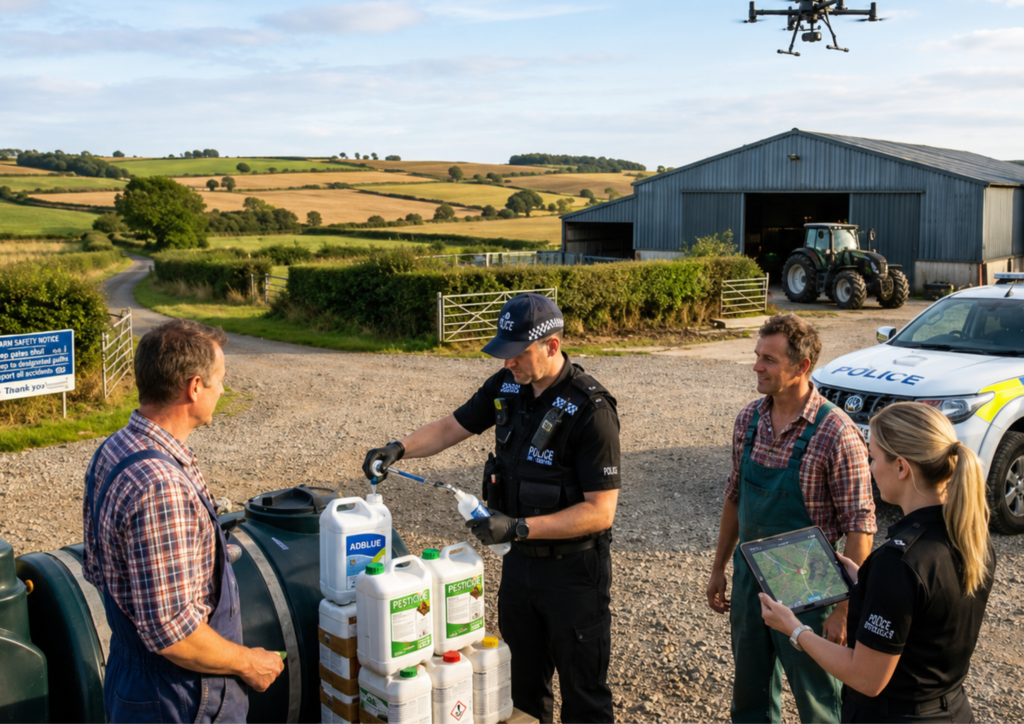
Drones: Visibility Where It Didn’t Exist Before
Unmanned Aerial Vehicles (UAVs) or Drones are becoming an increasingly useful tool in policing as they provide a bird’s-eye view of an incident, help locate people, track criminals, and support front-line decision-making in real time. As per a 2023 Government survey, UK police forces routinely use drones equipped with high-definition cameras and thermal imaging and have completed around 60,000 drone flights a year.
The NPCC Drone as First Responder (DFR) programme is conducting trials for remotely deployed drones that can reach an incident scene within minutes, streaming live footage directly to police control rooms. In these challenging rural landscapes where farms, fields, tracks and woodland can be difficult to monitor quickly from the ground, drones can help improve visibility, support evidence gathering, and assist with incidents such as illegal waste dumping.
GPS tracking: Recovering the stolen assets
GPS tracking can play a role in protecting high-value assets such as quad bikes and agricultural machinery. In 2024 alone, theft of quad bikes and ATVs reported to NFU Mutual cost an estimated £2.7 million, while GPS theft was estimated at £1.2 million, underlining the scale of the problem facing rural businesses. These tracking devices concealed within tractors, quad bikes, and trailers have become one of the most effective asset-recovery tools available to farmers.
When a theft occurs, live location data is shared to police, enabling rapid interception before stolen equipment crosses county or national borders. The continuous collaborative efforts between the National Rural Crime Unit (NRCU) and NFU Mutual led to the seizure of £4.4 million worth of stolen agricultural vehicles and machinery in 2024 alone. Hampshire police recommend using GPS tracking devices to at-risk rural vehicles, while a Home Office-backed scheme highlighted that tracking technology can alert owners when machinery moves outside a designated area and is being promoted to improve recovery prospects.
Forensic marking: Making theft less profitable
Forensic marking solutions, make use of a uniquely coded liquid to property that is invisible to the naked eye but detectable under UV light.
Once marked, equipment, machinery and other assets can be directly traced back to its rightful owner, even years after theft. Rural crime prevention guidance notes that property marking can deter offenders and improve the chances of tracing and returning stolen items and specifically recommends forensic marking solutions for higher-value equipment.
The government has now confirmed that it will introduce regulations requiring all new ATVs and GPS units to carry forensic markings and appear on a national property database.
What next steps do we need to take
Technology is not a replacement for policing, partnership working or strong rural policy, but it is becoming an increasingly important part of the response to rural crime which can be best used with a support of well-funded rural policing, partnership among various stakeholders and coordinated intelligence-sharing. Also, farmers and landowners should be supported to adopt these tools, and rural crime must be treated as a serious, organised threat and not a peripheral concern.