
NFU launch Cyber Security Guide for farmers
NFU launch Cyber Security Guide for farmers NRCN-member, the National Farmers Union (NFU), has partnered with the National Cyber Security Centre (NCSC) to produce an online booklet to support farmers in preventing and reporting cybercrime. Cyber-attacks are on the rise, they can be financially devastating, disrupting and upsetting to individuals and businesses. Cybercriminals aim to exploit human or security vulnerabilities in order to steal passwords, data or money directly, and the agricultural sector is no exception. Almost half (46%) of businesses identified cyber security breaches or attacks in the last 12 months. This criminal trend is an on-going threat to businesses of all natures and sizes, it is not just the larger organisations that need to invest in cyber security. Cyber security can often appear to be a complex and daunting subject, but prevention plays an important role in tackling the crime. The NFU hopes this booklet will provide farmers with practical, step-by-step guidance that can easily be implemented to build towards better resilience against cybercriminals and reduce their chances of being targeted. Download the guide here >>
Captive & Controlled – One Year On: Challenging Attitudes & Changing Lives in Derbyshire
Captive & Controlled – One Year On: Challenging Attitudes & Changing Lives in Derbyshire Derbyshire was one of the counties which took part in the 2019 research by the National Rural Crime Network and led to the Captive & Controlled report. For the first time, the differences between rural and urban domestic abuse were recognised in this way. And so, as Derbyshire, with the exclusion of Derby City, is mostly rural this report was of particular interest. By Emily Brailsford This need for a rural focus on domestic abuse was highlighted because of the different challenges that victims living in rural areas face. Derbyshire’s Office of the Police and Crime Commissioner considered this information carefully and decided to fund The Willow Project in February this year. This meant that there was only a matter of weeks to start work on the project, before the whole country was shut down by Coronavirus. Sadly this meant that domestic abuse was on the forefront of everyone’s minds. So instead of gently easing into our role, we had to hit the ground running here at The Willow Project. Our main focus is to raise awareness. In normal circumstances this would be done by giving talks and presentations, visiting community groups and country shows. But, because of lockdown we have had to change our plans and learn how to do all of this digitally. We also plan to deliver training to various different groups of people such as vets and school safeguarding staff, once we are safely able to. The last strand of the service is to recruit a team of ‘champions’, people within the community who will work to raise awareness around domestic abuse. The Willow Project isn’t a frontline service and champions won’t deal directly with victims, except in an emergency. What the project hopes to do, is to work closely with the amazing domestic abuse services we have here in Derbyshire, supporting them in raising awareness so that they can concentrate their time and their funding on working with victims. Hosted by Rural Action Derbyshire, The Willow Project aims to raise awareness around the different challenges faced by victims of domestic abuse living in rural areas. For more information on The Willow Project, please visit the website. Follow us on Twitter and Facebook, LinkedIn. Or email Emily Brailsford, Project Officer at e.brailsford@ruralactionderbyshire.org.uk or call her on 07594 088858
Captive & Controlled – One Year On: What’s Changed?

Captive & Controlled – One Year On: What’s Changed? In July 2019, the National Rural Crime Network revealed an alarming picture – the truth behind domestic abuse in rural Britain, with hidden victims being found to be ‘isolated, unsupported and unprotected.’ One year on from its launch, we consider what has changed since the release of the report, and whether there has been progress on the recommendations made. Last year’s report revealed that abuse lasts, on average, 25% longer in the most rural areas, the policing response is often largely inadequate, and the more rural the setting, the higher risk of harm. The harrowing findings of the report also revealed rurality and isolation are deliberately used as weapons by abusers. One recommendation which was made in the report, was a call for the government to apply its ‘rural proofing’ policy to domestic abuse, to account for specific needs of victims and survivors in rural communities. The Domestic Abuse Bill being introduced at the end of last year was a step in the right direction, however there is still more that could be done in order to reflect the needs or rural Britain. This Domestic Abuse bill is important though in order to be able to protect victims of domestic abuse and bring the criminals to justice and we should not underestimate its significance, particularly with the amendments which have been made during its progression through Parliament. Additionally, since the release of the report, an overhaul of family courts has been put in progress, striving to protect domestic abuse victims and their loved ones. This overhaul will give victims of domestic abuse special protections in court such as separate building entrances, waiting rooms, and protective screens to shield them from alleged abusers in court. This has been an immense change, supporting those vulnerable and exposed victims. Julia Mulligan, Chair of the NRCN: “We warmly welcome the news that the Government will be taking forward a range of measures to support survivors of domestic abuse and their children in the Family Court and to ensure that they receive greater protection. “For far too long, the support and protections that should be available to survivors of domestic abuse through the criminal justice process simply do not exist, and it can be a struggle from the moment the survivor steps into the Family Court. “We welcome the fact that, having taken note of feedback and conversations, the report had recommended positive change and collective improvement. We have been calling for this to change for a number of years and the announcement is an important first step; we must now ensure that the commitments announced today are delivered as quickly as possible.” One of the other recommendations included in the report asked for support services for rural victims to be improved. Our report highlighted the challenges in accessing these services if you lived a long way from an urban area, leaving victims often isolated and struggling to access help. A £2m fund was set up in the past year to try and combat that – to both support the victims and also launch a public awareness campaign. It emphasised the need for people to look out for vulnerable members of communities, in particular any victims of abuse, and was a welcome move. Despite these promising steps, there is still much more that can be done in order to further support rural services and victims. With many people experiencing the true meaning of isolation themselves this year, it is essential that momentum is continued to support those in need. It is feared that this funding, for example, which was also used for the public awareness campaign, will only offer short-term support for those needing it. With the current global pandemic also meaning the furlough scheme will be in place until October, there are now fears that more problems will arise at the end of the year, with demand for support on the rise. The domestic abuse support fund, also expected to end in October, might not offer support to those who need it when many of the perpetrators of abuse will, inevitably, return to work. Unfortunately, rural issues are all too often still overlooked, and such funding and support for victims is not distributed equally. The current pandemic has meant police attention has also been diverted elsewhere, potentially leaving victims alone, isolated and unsupported. After a 12 months the like of which none of us could have predicted, progress has been slow – but there has been progress. There needs to be much more though to support the victims who are still too often hidden away, captive and controlled.
NFU launch Farm Security Guide
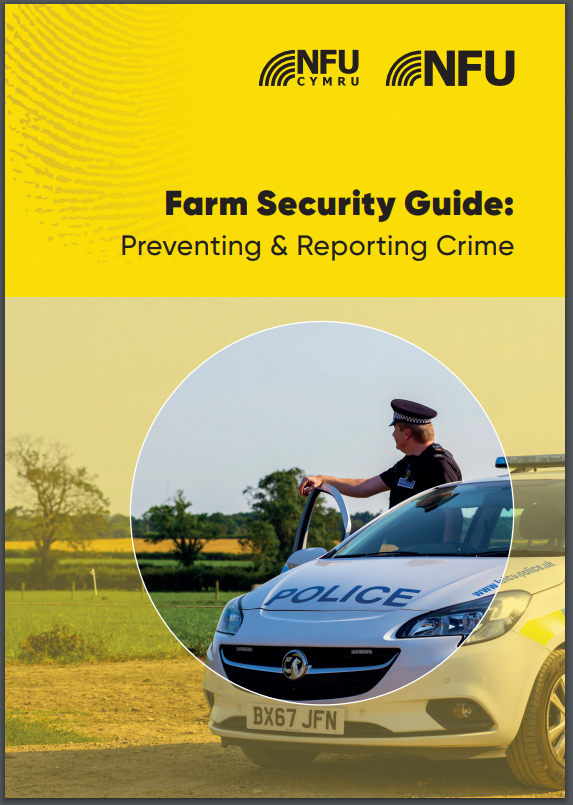
NFU launch Farm Security Guide NRCN-member, the National Farmers Union (NFU), have launched a “Farm security guide” to support its members in preventing and reporting rural crime. With the cost of rural crime at its highest since 2011, it is an ever-increasing policy area for the NFU. The organisation works hard to raise the issue of rural crime with the police, local authorities, and at the highest level of government. The NFU is dedicated to its members and provides the best possible support and advice. There are a range of tools currently available for farmers and landowners, including an online rural crime hub, a dedicated rural crime hotline, and a number of publications and reports. To further this, last month the NFU released a “Farm Security Guide” during its rural crime workshop at the NFU Conference 2020. The Farm Security Guide offers key advice to its members on measures they can take to protect their farming business and how to report a crime effectively. Prevention plays an important role in reducing rural crime, and by putting a few measures in place, farmers can reduce their chances of being targeted. Farms are often not only businesses but also family homes, so it is important to take every appropriate measure to protect them. Inside the manual, there are 10 crime prevention tips for your property/land. The NFU has also partnered with several leading security and service brands to offer members exclusive discounts. Through a close working relationship with the police, the NFU recognise the importance of reporting a crime effectively. Not only is it important to gather data on rural crime, but it is also vital to give the police as much relevant and accurate information as possible. The booklet provides an essential step-by-step guide to reporting crime, specific to different offences, to ensure our members have the appropriate information. So far, the guide has received positive feedback, and the NFU hopes that by sharing this knowledge with farmers and landowners, we can tackle rural crime with a consistent and coordinated approach. You can download it here >>
RSPCA Inspectors join fight against Domestic Abuse in North Yorkshire
RSPCA Inspectors join fight against Domestic Abuse in North Yorkshire 20 RSPCA Inspectors recently took part in training coordinated by North Yorkshire Police to help them spot the signs of domestic abuse and know how to report it. The training is the first of its kind and was delivered in partnership between North Yorkshire Police, Independent Domestic Abuse Services (IDAS), Victim Support North Yorkshire and the RSPCA. Officers from North Yorkshire Police’s Rural Taskforce helped to set up the training day which was opened to RSPCA Inspectors across the North of England. North Yorkshire Police Inspector, Jon Grainge said: “Partnership working is fundamental to tackling all aspects of crime and the idea for this training came about during discussions with the various organisations involved. Many of the locations in which our officers and RSPCA Inspectors work are rural and sometimes very isolated so can be particularly vulnerable and we hope this training will provide another important tool in supporting these communities.” North Yorkshire Police Domestic Abuse Coordinator, Rebecca Cobby, said: “The training was really well received by everyone who attended and is a fantastic example of how effective partnership working can be. “The National Rural Crime Network ‘Captive and Controlled’ report 2019, showed that domestic abuse lasts on average 25 per cent longer in the most rural areas. One of many factors contributing to this is that victims may have animals and livestock that they need to care for, making it more difficult for them to leave their abuser – further highlighting the importance of this partnership. “The more eyes and ears who can help spot the signs and know how to report domestic abuse, the greater support for victims and the more people who can be armed in the fight to put a stop to domestic abuse.” RSPCA Inspector and National Wildlife Officer Coordinator, Geoff Edmond, was instrumental in coordinating the training. He said: “The RSPCA Inspectorate welcomed the opportunity to work in partnership with North Yorkshire Police and IDAS. The recent training day held at North Yorkshire Police HQ allowed our Officers not only from North Yorkshire but from across the North East of England and Lincolnshire to gain a greater understanding and awareness of domestic abuse and how to work together across partner agencies to help safeguard those at risk.” Feedback from participants included: “I really enjoyed it course I found it highly informative and the information was very relevant to our role, I could think of examples of the sort of things we discussed and feel much better prepared for spotting the signs and directing people to help/support.” “I found it very informative and eye opening and I learnt a lot about signs of abuse and how to go about reporting it if I suspect there is a domestic violence issue at an address I attend.” Read more about our report on Domestic Abuse in Rural Areas here >>
Rural Crime Week of Action in Warwickshire

Rural Crime Week of Action in Warwickshire During the week, as part of the national Rural Crime Week of Action, officers from around Warwickshire, including the new Rural Crime Team – launched during the week, have been proactively engaging with rural communities at events, engagements and on their beat areas. Meetings and engagement events attended have included Young Farmers Meeting at Dunchurch, Warwickshire British Horse Society, the livestock markets at Stoneleigh (Rugby market) and Stratford, a horse tack marking event, NFU, West Midlands Border forces meeting, visit to Warwickshire & Nuneaton Wildlife Sanctuary with the cadets and Alex Goodwin, plus an SNT event in Fillongley village hall. Patrols and visits have been conducted to address poaching, coursing, heritage crime, wildlife, equine, angling incidents, fly tipping, speeding, parking, antisocial behaviour, numerous farms and rural businesses across the whole of the county. High visual patrols have been conducted in villages and rural areas where concerns have been made. Social media was also used throughout the week to promote and inform the rural communities and partners of the work of the force in tackling rural and wildlife crime and the activities that have taken place. Read more about the new Rural Crime Team here >>
Putting the spotlight on domestic abuse in Avon & Somerset
Putting the spotlight on domestic abuse in Avon & Somerset Between the 25 November and 10 December, Avon and Somerset Police are marking the 16 Days of Action against Gender Based Violence, which began with the UN International Day for the Elimination of Violence against Women. By Superintendent Deryck Rees The premise of the 16 days of action is to raise awareness of the fact that women around the world are subject to rape, domestic violence, and other forms of violence; it’s an opportunity to highlight the scale and true nature of an issue that is often hidden. The focus of our campaign, this year, will be on the issue of domestic abuse in rural areas, where victims can feel more isolated, and may find it harder to access services than those living in more urban areas. According to the National Rural Crime Network’s research: Domestic abuse, on average, lasts 25% longer in rural areas. Rural victims of DA are half as likely to report their abuse to others. Close-knit rural communities can keep DA hidden, facilitating abuse. Rurality and isolation are used to the advantage of abusers. Support services are scarce, less available, visible, and effective. Rural victims are isolated, unsupported, and unprotected in rural areas, which is ‘normalised’. Throughout the 16 days, we will be striving to build community cohesion in rural areas by encouraging those living in more isolated locations to look out for the signs of domestic abuse and how they can report to the relevant services. Our PCSOs will be attending Talking Cafes across Avon and Somerset to talk about domestic abuse and shed light on the services available to survivors. There is no ‘them and us’ when we’re thinking about victims and survivors of domestic abuse. They are our friends, our family, our neighbours and our colleagues. It’s not always easy to immediately recognise the signs that someone is being abused. But, we are encouraging those who notice something isn’t quite right with a friend, neighbour, or someone from their community, to look, listen, as and ask again. Some of the things to look out for could be a friend being texted an inappropriate number of times by their partner when they aren’t together, a sudden lack of contact from someone, or overhearing abusive language from neighbours during an argument. During the 16 Days of Activism we want to send the message that domestic abuse isn’t something limited to urban areas, it can happen anywhere, and to anyone. We all have a responsibility to look out for the signs of someone being manipulated and abused. If you do decide you would like to speak to the police, you can call 101. Or you can get advice from specialist services in your area. If you or someone else is in immediate danger – call 999.For more information about domestic abuse, please visit www.thisisnotanexcuse.org
Welcome from Simon Prince

Welcome from Simon Prince As the National Policing Lead for Rural and Wildlife Crime my role is to give guidance and direction on the development of policing services, akin to the two areas of responsibility, to all police forces in England and Wales. As the National Policing Lead for Rural and Wildlife Crime my role is to give guidance and direction on the development of policing services, akin to the two areas of responsibility, to all police forces in England and Wales. Wildlife crime is catered for with the National Wildlife Crime Unit playing a major role in standardising investigations and linking up many partnerships with various other law enforcement agencies and Non-Government Organisations. Rural crime, however, is difficult to define hence the portfolio has to look closely at this area of policing not just as a crime issue but more broadly as ‘rural affairs.’ Rural based crime and issues that can affect rural life has many anomalies to urban crime. Although the categories of crimes are the same e.g. theft, burglary, drugs etc. their impacts on rural communities can be far reaching. A burglary in a town of 20,000 people may only impact on a small percentage of that community. The same burglary in a village of 200 people, however, can impact on all the residents. Replicate this in every hamlet, village and small market town in England and Wales and you can quickly see how important it is for policing to get it right. Building the trust and raising confidence in our rural communities is paramount for rural policing to have the desired impact. We need to listen, take action, tackle, disrupt and prevent crime and anti-social behaviour in our rural communities. Although crime rates are falling we must strive to bring offenders to justice and by working better and smarter with our rural communities we can achieve this. The National Rural Crime Network can assist operational policing in achieving our goals. It can listen to and speak on behalf of the rural communities ensuring that on the ground policing is tackling the important issues, however small they may seem to others. By highlighting the issues, it can influence the guidance and direction taken in rural policing. By working with the College of Policing, we can collectively develop working programmes and Authorised Professional Practices that can deliver the appropriate service to our rural communities. I look forward to working alongside the NRCN.
Welcome from Julia Mulligan

Welcome from Julia Mulligan Growing up on a hill farm, and now being the Police and Crime Commissioner for the largest rural police force in the country, I am acutely aware of the blight rural crime can have on our more isolated people, communities, and businesses. Through no one’s fault, rural crime has fallen down the agenda, now seemingly an afterthought coming a distant second behind ‘serious’ crime in ‘urban’ areas. That needs to change, and it is changing. The National Rural Crime Network (NRCN) is a positive step forward, highlighting the needs of rural communities and the exploring the toll of hidden crime. Those of us involved in the NRCN, and anyone supporting our cause, will be writing blog posts to keep you up to date with developments. With everyone’s help we can make sure rural crime is front and centre of the police’s mind. To start us off on the right track we have developed this website. A place to share ideas, best practice and much else besides. Please do keep coming back to check for updates because our aim is to make this site as relevant and practical as possible. We are also undertaking what we hope is the biggest ever survey of rural residents and business (aside from the census) to really find out what impact crime has on you. It is your chance to tell us how you feel, and we hope it will shape the future of police services in our rural communities for years to come. Supported by the BBC, the NFU and many others besides, we hope to publish the results of the survey at the end of the summer. So, whilst there is a long road ahead to make sure rural crime, and rural services more widely, are given the prominence they deserve, we hope the National Rural Crime Network is the first step on that road. But none of it will work without your support. Please come back to check the website regularly. If you would like to promote the 2015 National Rural Crime Survey or to be contacted once it is live, please send us your contact details.